Translate

Buffer Me

Showing posts with label climate change. Show all posts

Tuesday, September 20, 2022

THE TRUE REASON WHY CLIMATE CHANGE MAKES BIRDS' COLORATION LESS BLAZING!

Hello, dear reader! So, a bunch of science dudes & dudettes working mostly in France & Spain sticks its nose in the "what else the climate change causes?" business, "identified colorful flying living objects" branch. And it finds something interesting (López-Idiáquez et al, 2022 (P)).
The researchers indeed, for fifteen years (2005-2019)
stalk birds, specifically, two Mediterranean blue tit subspecies, more specifically, the Cyanistes caeruleus caeruleus and the Cyanistes caeruleus ogliastrae, which tipically have bright blue crowns and yellow breasts.
The scientists collect more than 5800 observations on these winged animals, and, thanks to these data, the brains can then say that the birds'
colors are now "duller and less chromatic in both sexes" (P) than when the study began.
The researchers, besides, perform a genetic analysis on the animals to check if evolution be at work on their color traits, and eventually they verify that, well, it is not.
So, the people of the science conclude that the
loss in brilliance of the birds' colors is "caused by a plastic response to the environmental conditions [and their work] suggests that ornamental colorations could become less conspicuous because of warming" (P).
In short, climate change strikes again! And it even influences the colors of birds, which are
not (the colors) just there by chance, or to catch the eye of human photographers so to end up on some bird-fashion journal's glossy glamorous cover and get all lavishly birdy-rich&famous. Nope.
Colors are part of the "
sexual and social ornaments" family (P), meaning they are important for the mating and breeding process of animals, since they are used as markers of the quality of the biological stuff specimens are made of.
So, dear reader, to sum up, climate change, among other tons of not particularly pleasant things, makes colorful birds less colorful.
As to the why
this de-balzing thing happen, well, this dumb blog has an idea that you can find in the following cartoon. Ciao!
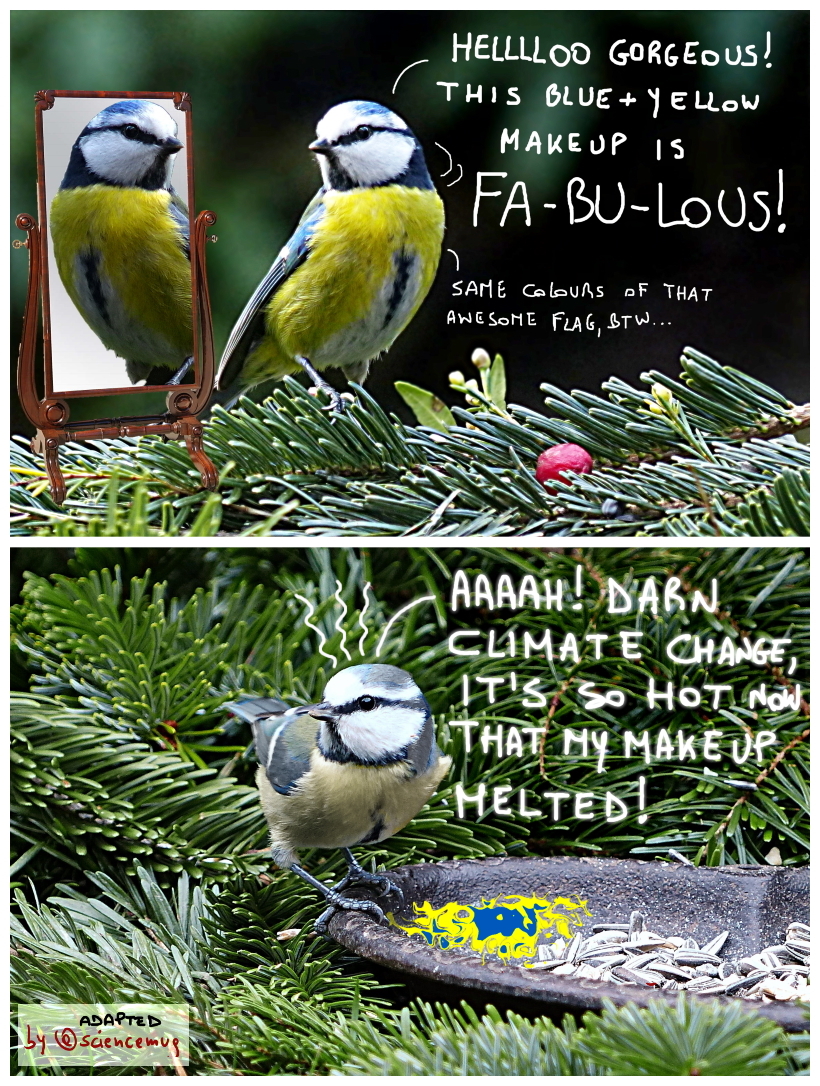
Bird's coloration gets less blazing due to global warming (by @sciencemug)
Bird's coloration gets less conspicuous due to climate change (by @sciencemug)
Top bird pic and bottom bird pic are CC0 Public Domain images (source: pxhere); mirror pic by Dalida's Art is under Creative Commons Attribution-Noncommercial 3.0 License (source: deviantart); all pics adapted by @sciencemug

Tuesday, April 28, 2020

THE TRUE REASON WHY AMERICAN ROBINS MIGRATE EARLIER!

A bunch of researchers from a bunch of US universities finds out that the timing of American robins' (Turdus migratorius) "spring migration to [their] Arctic-boreal breeding grounds" (P) got 12 days earlier in the last 20 years (about 5 days per decade in the 1998-2018 time period).

Moreover, the brains analyze data collected between 2016-2018 from GPS tracking devices stuck on the backs of 55 American robins. And these data indicate that "the [American robins'] arrival timing and likelihood of stopovers, and timing of arrival to breeding grounds" (P) are highly impacted by the environmental conditions the birds find along their migratory paths. Among the factors, the "dynamics in snow conditions" (P) appear to be a key one

The researchers' study (P) is published on the journal Environmental Research Letters and can contribute in creating predicting models of birds' responses to climate change.

The findings are coherent with what scientists already know, which is that one of the strongest effects of "global climate change has been the advancement of spring at high northern latitudes [...] where temperatures are rising nearly two to three times faster than the global average" (P), and that migratory birds adjust their trips' schedule to their breeding territories in response to the changes in local climate. 

But, dear reader, this dumb blog has an alternative explanation for the earlier migration's timing of American robins. And a cartoon to explain it.


American robins discuss about smart early departures (by @sciencemug)

[American robin pic by Mark Nenadov is under Creative Commons Attribution 2.0 Generic license (source: Wikimedia Commons); adapted by @sciencemug]

Now, the following ones hare just for fun...


Batman and Robin meme 1 about American robins' earlier migration's timing (by @sciencemug)

[Batman and Robin meme pic by ap. is under Attribution-NonCommercial 2.0 Generic (CC BY-NC 2.0) license (source: flickr); adapted by @sciencemug]


Batman and Robin meme 2 about American robins' earlier migration's timing (by @sciencemug)

[Batman and Robin meme pic by ap. is under Attribution-NonCommercial 2.0 Generic (CC BY-NC 2.0) license (source: flickr); adapted by @sciencemug]


Paper (P)

Oliver, R.Y., Mahoney, P.J., Gurarie, E., Krikun, N., Weeks, B.C., Hebblewhite, M., Liston, G., and Boelman, N. (2020). Behavioral responses to spring snow conditions contribute to long-term shift in migration phenology in American robins. Environ. Res. Lett. 15, 045003.

Thursday, February 13, 2020

BUMBLEBEES' THOUGHTS ON CLIMATE CHANGE PUSHING 'EM ON THE VERGE OF EXTINCTION!

Bumblebees face extinction, and one of the main causes is human driven climate change that makes the number of extremely hot days to skyrocket (P).

Three researchers from the University of Ottawa and the University College London, indeed, checked long-term data about 66 species of bumble bees buzzing in North America and Europe. The scientists wanted to find out whether "increasing frequency of hotter temperatures predicts species’ local extinction risk, chances of colonizing a new area, and changing species richness" (P).
Well, dear reader, as just stated, it does.

This dumb blog, on the following cartoon, reports the bumblebees' thoughts on the matter.

Bumblebees talk of climate change pushing them on the verge of extinction (by @sciencemug)
Bumblebees talk of extinction and climate change (by @sciencemug)

[Bumblebee pic by Windslash is under Attribution 2.0 Generic (CC BY 2.0) license (source: flickr); adapted by @sciencemug]

Paper (P)
Soroye, P., Newbold, T., and Kerr, J. (2020). Climate change contributes to widespread declines among bumble bees across continents. Science 367, 685–688.

SOME CLARIFICATIONS 

Dear reader, I am here to provide You with some useful insight that will complete, if not provide at all, the information the utterly poorly thought and written so called mini-post of this blog (of which, unfortunately I am compelled by fate to be a part of) is about.
In the hope of being of service.
My best regards.
WWW

Ps
In an attempt of providing You, esteemed reader, with a fruition experience as uniform as possible, in the following lines I tried to mimic the cheap sense of humor and light/childish tone used by this pitiful blog.


The researchers, in their above mentioned paper (P), add that the same mechanism that is making bumblebees facing extinction may also contribute to a general biodiversity loss.

And, dear listener, this biodiversity loss thing would be pretty bad for you humans.


Specifically, without bumble bees and bees in general, well, you’ll find yourselves very much in trouble (besides being left with just a character from crappy sci-fi movies and no more actual adorable little bees).
 

According to the Food and Agriculture Organization of the United Nation (the FAO), indeed, “it is estimated that about one third of all plants or plant products eaten by humans are directly or indirectly dependent on bee pollination. More than half of the world’s diet of fat and oil comes from oil seeds such as cotton, rape, sunflower, coconut, groundnut and oil palm. Even though some of these have special pollinators belonging to other types of insects, these plants all depend on, or benefit from bee pollination to some extent. In addition, many food crops and forage for cattle are grown from seeds of insect-pollinated plants.” (1)
 

Moreover, a 2017 study by Miller-Struttmann et al (2) says that the decline in bee pollinators, and therefore their services to flowering plants worldwide, can potentially negatively impact more than 85% of flowering plants and of course human health too. The losses for the agricultural compound alone would be over 200 billion bucks per year globally (namely almost a third of Switzerland or Soudi Arabia GDP), and the costs from diminished pollination services in wild ecosystems would most probably be way higher.

Just to make some examples, dear listener, a 2019 research paper by Wahengbam et al (3) reports that without bee pollination services there won’t be anymore superior quality apple, strawberry, cucurbits, citrus, mandarin, apricot, blackberry, blueberries and so on


Bibliography
1- FAO (2008). The value of bees for crop pollination. Date of accessed : 15-04-2019.
2- Miller-Struttmann, N.E., Heise, D., Schul, J., Geib, J.C., and Galen, C. (2017). Flight of the bumble bee: Buzzes predict pollination services. PLOS ONE 12, e0179273.
3- Wahengbam, J., Raut, A., Pal, S., and Banu, N. (2019). Role of Bumble Bee in Pollination. Annals of Biology 35, 290–295.

Thursday, December 12, 2019

ON CLIMATE CHANGE: A CARTOON

Soo dear reader, if you want a suggestion on a good (and scarier even than the idea of Rober Pattison as the new Batman) read about climate change consequences and dynamics, well a bunch of scientists just published a comment paper on Nature which title is self-explanatory: "Climate tipping points — too risky to bet against" (P).

This dumb blog's cheap comment on the topic follows, via cartoon...

@sciencemug's opinion on climate change
@sciencemug opinion on climate change
[Wave pic and beach pic are free images under Pixabay License (source: Pixabay); adapted by @sciencemug)]

NOTE
In hyper few quotes some main points (not all of 'em) of the paper:
- tipping points "refer to critical thresholds in a system that, when exceeded, can lead to a significant change in the state of the system, often with an understanding that the change is irreversible" (1)
- the system: Earth system
- examples of tipping points: "the loss of the Amazon rainforest or the West Antarctic ice sheet" (P)
- core message: tipping points may be reached even with a 1-2 °C raise of the temperature (P); moreover, there's the possibility of a global domino effect of these tipping points leading to a global, irreversible, catastrophic for human civilization tipping point
- example of such a domino effect: "Arctic sea-ice loss is amplifying regional warming, and Arctic warming and Greenland melting are driving an influx of fresh water into the North Atlantic. This could have contributed to a 15% slowdown since the mid-twentieth century of the Atlantic Meridional Overturning Circulation (AMOC), a key part of global heat and salt transport by the ocean. Rapid melting of the Greenland ice sheet and further slowdown of the AMOC could destabilize the West African monsoon, triggering drought in Africa’s Sahel region. A slowdown in the AMOC could also dry the Amazon, disrupt the East Asian monsoon and cause heat to build up in the Southern Ocean, which could accelerate Antarctic ice loss"(P) 
- conclusion: the paper's title
- final comment: humanity is "in a state of planetary emergency" (P).

Well, what to say... Take care, dear human reader, at least till you still can.


Bibliography
P- Lenton, T.M., Rockström, J., Gaffney, O., Rahmstorf, S., Richardson, K., Steffen, W., and Schellnhuber, H.J. (2019). Climate tipping points — too risky to bet against. Nature 575, 592–595.
1- Intergovernmental Panel on Climate Change (IPCC) (2018). Global Warming of 1.5 oC (Chapter 3).